Two grounds, and two different trades.
On the open web, we search, we get things removed, and we prepare the legal next step if removal is refused. On closed networks, we search too, but nothing can be removed and nothing can be filed: we tell you what circulates, and that is already a lot.
- Step 01We search where your data leaks
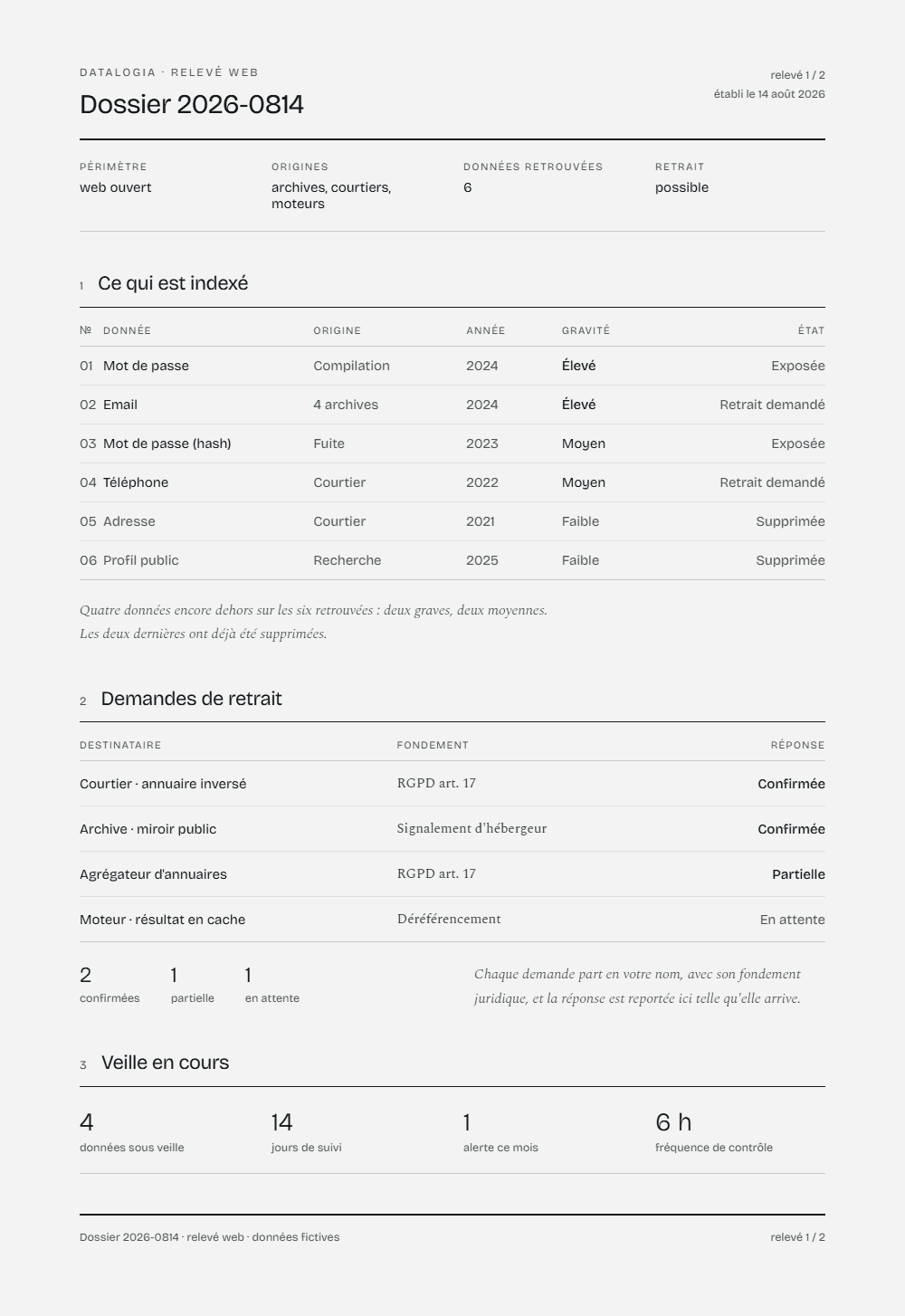
Leak databases, passwords stolen by infostealer malware, the sites where your email, username or phone number has an account, and the reputation of your IP addresses and domains.
- Step 02We request removal
One erasure request per source that allows it, sent in your name under article 17 of the GDPR. A leak cannot be taken down: it goes under watch instead. Each answer is recorded in your file.
- Step 03We go legal
If the source refuses or does not answer, there are still ways: formal notice, complaint to the data protection authority (the APD in Belgium), referral to the authority of the country concerned. It is the last floor, and it only exists where the law applies.
- A report of what is indexed, source by source, with the date
- Removal requests sent and followed up to the answer
- A watch that alerts if an item reappears
- Legal recourse when removal is refused
- Erase a file already resold elsewhere
- Reach what circulates outside the indexable web
- Compel a source outside the European Union
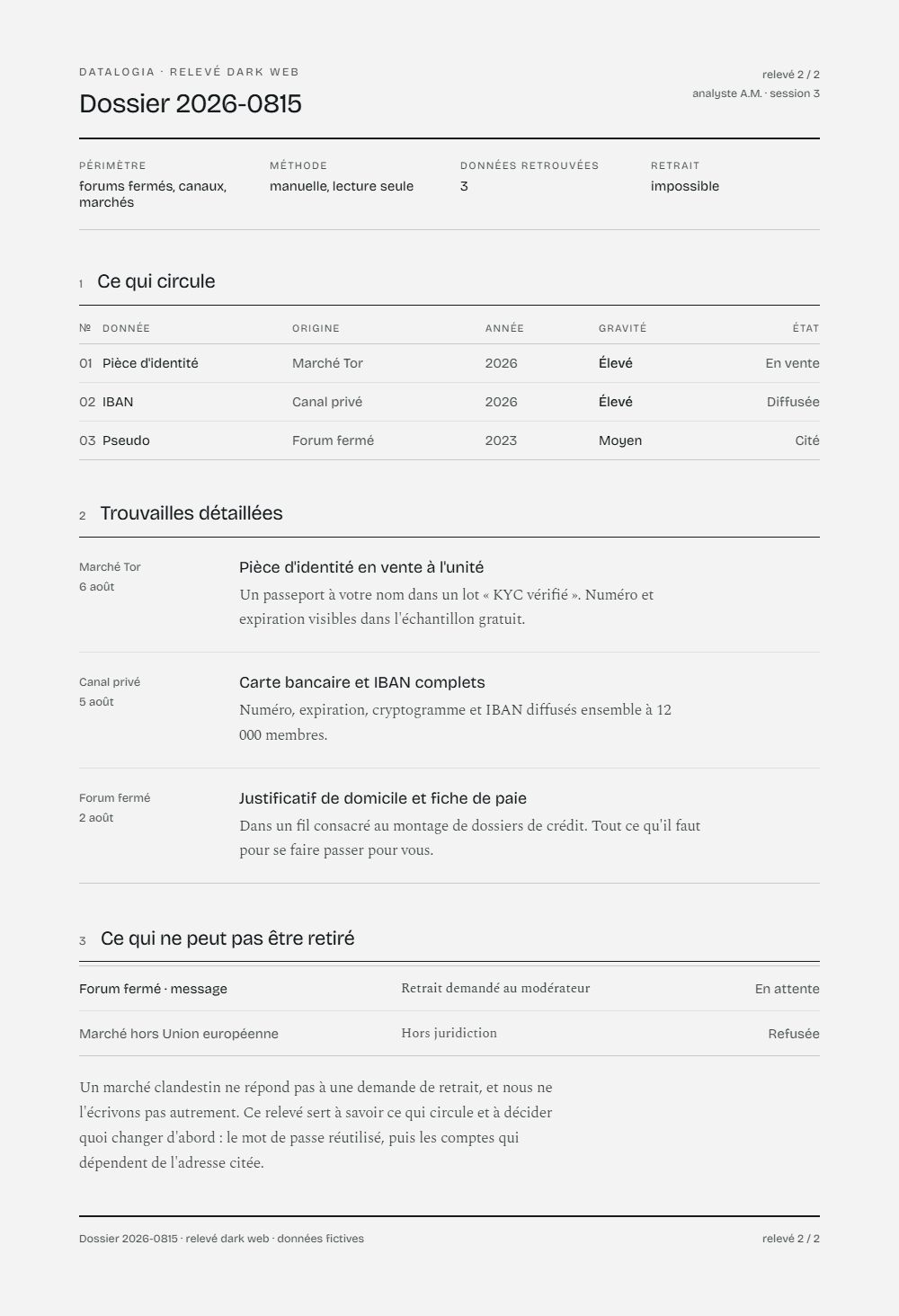
An analyst looks for your name where no tool gets in: private channels, closed forums, onion services, resale markets. Read only, without ever making contact or buying anything.
There, no removal is possible and no recourse exists: there is nobody to send a request to, and no law applies. What you get is to know, and to know what to change first.
French leaks of the last two years have put tens of millions of records in circulation. On a French address, a report comes back with something far more often than on a foreign one.
- Private resale channels
- Closed forums, where access is earned
- Onion services and dark web markets
- “Verified” batches and free samples
- No removal request: there is no recipient
- No legal recourse: no law applies there
- No guarantee of completeness, only the sources covered
The report is delivered even when it finds nothing: it then says what was covered, and on which date.
Both, line by line
| Open web | Closed networks | |
|---|---|---|
| Where we look | Open, indexable sources | Private channels, closed forums, onion |
| How | Automatic, then every week | By hand, on request |
| Removal | Requested and followed | Impossible |
| Legal recourse | Formal notice, data protection authority | None |
| Time | Demo within 24 h, removals reviewed before sending | Report within 48 to 72 h |
| Price | Subscription from 19,90 € / month | 10 credits per item checked, 9 on Pro, 8 on Elite. Without a subscription too. |
Both services are paid with the same credits, the ones your subscription grants every month or the ones from a pack. The manual report costs less on Pro and Elite. It is ordered from the client area and opens no removal: where it looks, there is nobody to ask.
Sample reports
Both documents concern the same identity, which is fictitious. It is exactly what you receive, with nothing hidden.
Start with the free side
The web report demo is free. It needs an account, and the masked report arrives by email within 24 hours. The manual report is decided afterwards, if the first is not enough.